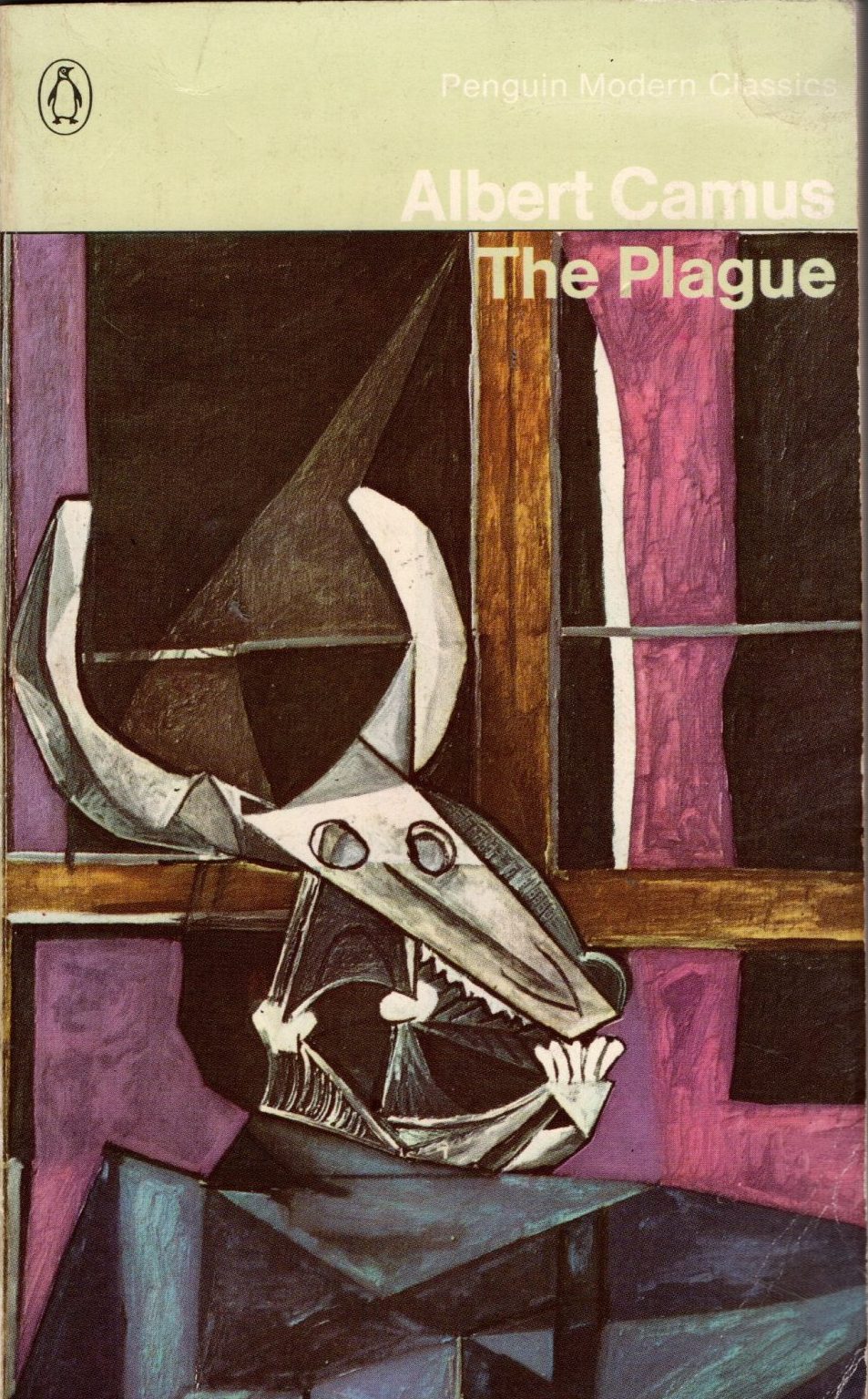
In a moment of Sunday comfort, I sat down with a cup of tea and pulled a book from one of my shelves. It was an anthology of existentialist writings. Admittedly, it has been many years since I thought seriously about existentialism. With many dusty pages turned, I started to reflect on the numerous inscriptions the younger version of myself had scrawled in the margins. Motivated, I pulled another book from the shelf, this time a collection of essays by Camus. What was supposed to be some light, cosy reading over a cup of tea turned into an afternoon absorbed by the question of meaning. The day ended with reflection on Camus’ The Plague.
What occurred to me, as I read one classic short story or essay after another, is that, despite the many reasonable criticisms one might levy against existentialism, its importance as a movement of thought is preserved by the way it captures something fundamental about human beings: the propensity toward the absolute. All mythologies and religions, in one way or another, would seem to share this very simple, common root. But so, too, it would seem, many other habits of thought.

Indeed, if mythology and religion are rather low-hanging fruit, a more peculiar example came to mind that afternoon: the recent resurgence of scepticism toward germ theory. Camus’ story The Plague, especially the priest, Father Paneloux, is influential in thinking of this example.
It is Paneloux who suggests, during a sermon, that the plague is God punishing the city’s sinfulness. His interpretation of the plague turns apparently arbitrary suffering into morally intelligible suffering. The plague is no longer contingent; it occurs because of something. His position is then severely tested by the agonising death of an innocent child, after which his second sermon becomes considerably more difficult and ambiguous. It is not that Paneloux should be viewed as a simple caricature of religious irrationality. The point is much more about uncovering the psychology of his struggle.
As an exceptionally talented writer, Camus is a master at exposing the subtleties of human experience. He has a way of teasing out basic human motivations through the perceptions and actions of his characters. It is as though one is looking through a window such that the characters themselves, and the literary devices within the novel, blend into the experience of daily life. Camus’ notion of the Absurd, which acts as a metaphysical acid bath that washes over everything, is no exception. Since Paneloux’s initial theological explanation can be understood as a response to the absurdity of the suffering laid bare before him, Camus exposes something familiar to the reader: faced with a cause invisible to the unaided senses, and with consequences that appear arbitrary in their distribution, there is an unnerving quality to the epistemological gap that the desperate mind anxiously wants to fill with whatever explanation feels most satisfying.
A more ordinary expression of this cognitive tendency can be viewed in less dramatic circumstances than a plague. On the level of experience, it derives from giving explanatory weight to what is most immediate and perceptible, often at the cost of equating correlation with causation. I find this tension to be reminiscent of the pattern of reasoning I have read from contemporaneous germ theory sceptics. Since understanding pathogens is experientially difficult, it often times seems the correlation most immediate to the senses appears the most convincing. Quite simply, this is why, if one falls ill with a cold, it must therefore be due to having been caught outside in the rain!
Germ theory is among the best-established foundations of modern biology and medicine. The complex reality it captures is less than satisfying when viewed from the perspective of a desperate actor. Disease severity reflects interactions among several factors, in which asymptomatic carriage is entirely compatible with microbial causation: pathogen, host immunity, genetics, inoculum, prior exposure, environment, and even chance, all play a role. The world it describes is one in which causes may be invisible, consequences disproportionate, and individual outcomes uncertain. This may be difficult to accept, as basic and as foundational as it may be.
Since germ exposure does not produce identical outcomes in every person, and since infection and illness are governed by biological processes containing stochastic elements and epidemiological outcomes that are appropriately modelled probabilistically, the gap appears in how one may choose to give as much priority to the appeasement of an Idol as washing hands. Although only one of the two options would be reasonable, a reader of history knows that, in the distribution of human beings, there will likely be those who choose the Idol.
It is precisely the uncertainty of existence that alternative theories can appear to resolve. A doctrine according to which illness results entirely from one’s internal “terrain”, purity, diet, state of mind, or some other controllable condition offers a form of consolation structurally similar to Father Paneloux’s account of divine punishment: the promise that suffering can be made wholly intelligible, or, perhaps more pointedly, the promise of intelligibility as comfort without remainder. If health follows necessarily from correct living, then contingency disappears. Illness becomes explicable, perhaps even deserved, and, most importantly for the observer, controllable. If I do the right things, what happened to them cannot happen to me. The proposition may be scientifically false, but its psychological attraction is not difficult to understand. Randomness, the roll of the biological dice, has been replaced by moral or personal order.
This is where my afternoon with the existentialists returns to mind. The problem is larger than germ theory. Human beings seem remarkably uncomfortable with contingency: with events that have no regard for virtue, intention, or deservingness. A virus does not care whether its host has lived well. Nature does not arrange probability according to moral worth. Camus understood this particularly well, which is perhaps why The Plague remains such an effective existential novel. Faced with pestilence, I think of Rieux, who finds what certainty he can in “everyday work”; beyond it lie contingencies over which one possesses no final command. The answer is not metaphysical reassurance but lucid acknowledgement followed by action.
Perhaps, then, germ-theory denial can be understood, in part, as one minor expression of a much older existential impulse. The attraction is not simply ignorance of microbiology. It is the temptation to exchange an indifferent and probabilistic world for one in which everything happens for a comprehensible reason and everything important can, in principle, be controlled. Sartre might have recognised something of bad faith in the manoeuvre: “if I live correctly, I can render myself entirely immune to contingency” resembles an attempt to deny facticity and finitude. Science, and the inherent demands of rational discourse, asks something rather more difficult of us. It asks that we accept a world whose regularities can be understood with extraordinary precision, while conceding that understanding those regularities does not grant us absolute security within them. I suppose this is one reason the existentialists continue to be worth taking down from the shelf.


Leave a Reply