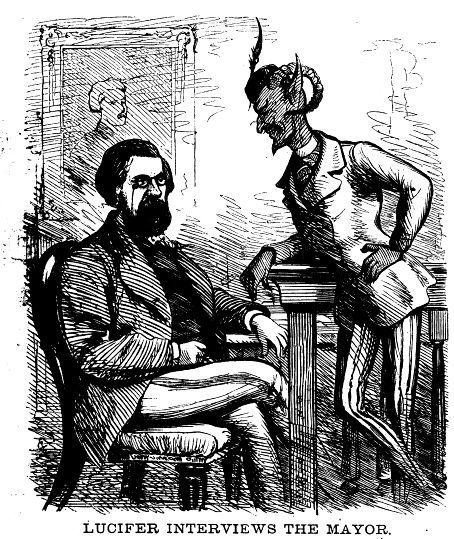
Charles Baudelaire wrote in the prose poem Le Joueur Généreux (The Generous Gambler), “the greatest trick the Devil ever pulled was convincing the world he didn’t exist”. Baudelaire, the father of modern poetry, had a keen eye for the gritty details of human life. Many of his poems focused on exposing the ugly side of human nature, serving as a study on the dark contents of life that become normalised and mediated into the background of experience. In his masterpiece, Les Fleurs du Mal (The Flowers of Evil), Satan is an active, structural presence, much like a force receded untraceably into a system. One reads of the Devil, as the master of cunning and deception, an undefinable figure that passes from shadow to shadow, as the supreme manipulator of human beings.
But if we were to permit ourselves to be serious for a moment. The precise formlessness of the Devil has always struck me as curious, in that maybe this myth is symbolic of a social form. Much to the respect of Baudelaire’s poem, one detects in the belief of the formless shape of the Devil the social pretext of a cunning and evil order that has more to do with humanity than with a supernatural entity. If in a moment of lucidity we were to stand up to the Devil and drag him back into a world of concrete terms, it would be seen that the very aura that we have long attributed to his evil is actually representative of the condition of society and the ideological structure beneath it. I am not alluding to political ideologies such as leftist or rightist politics, but rather the ideological structure in which both leftist and rightist politics share and are seemingly unable to question. The precise formlessness of ideology, which is the pretext of most social evil, is analogous to the myth of the Devil.
The conception of the Devil in the classical age, embracing both the inward and outward existence of evil, is more befitting of the individual’s social position than some crude suspicion of invisible influences. On the other hand, if the visible influence of our present state of affairs is the measure of evil in an act of human destruction, whether as a murderous rampage or economic exploitation, then it is only consistent with the bad social context which tangibly underwrites the very character of an evil act. Responsibility is always in the hands of the individual, but an act of evil also has some connection to the underlying barbarity of the social reality which arguably breeds crime and fosters inherent irresponsibility. In this respect, the fundamental tragedies that overwhelm human history are not at the hands of shadow and spectacular myth. Rather, they lay in the bloodied hands of the individual and the moral and savage squalor of barbarity.
Nevertheless, the destructive complex of human society has always been the result of our common consent of refusal to pull all acts of evil downward into the human realm of possibility and the social context which may or may not affirm that possibility. Thus the entire meaning behind the myth of the Devil is to deflect responsibility toward a magical presence beyond the social situations we collectively construct and, in turn, to pretend that this magical presence represents the supreme commander of the impulse we might feel when engaging in a destructive act (a sort of “double negation”). In this way, the myth of the Devil can easily be seen as a psychological projection of what Sartre described as the anguish or anxiety that often follows the existential realization of choice and responsibility.
In another way, the myth of the Devil can also be seen as a psychological projection of something we are all familiar with but feel powerless against: destructive social forces, the violence of history, and the continuing of prejudiced political subjectivities. Both points represent an extended history of the human drama. However, it is the latter that is seem as most common theme. If we look into this socially common feeling, this typical experience which reaches beyond most borders and is expressed by citizens of all nationalities, what we get is a glimpse into the fundamental tragedy of the human universe. And it is here where the old notion of the Devil feels most suiting, because operating in the background of the common, daily tragedy of the human social world is an ideological structure which is central to most social evil. The fiendish prejudiced or ideological modes of subjectivity operating in the background of society, in its systems, and as a dominating epistemology – this is a pathological social world that rejects reasoned, enlightened and critically enquiring debate. It is what defines the very status of “ailing society” – that is, the social structure which pressurizes irrational action. Perhaps this is the real Devil?
On the basis of this retrieval of the Devil, moreover, surfaces an analogy to the “bad social context” in which we are forced to exist and struggle against on an everyday level. As a symbol of ‘coercive society’, one that more often than not creates the prerequisite situations in which one is pressured or coerced into acting in life distorting and destructive ways, the meaning of the Devil is on par with the human context. The very existence of the Devil as myth represents a projection of human powerlessness against greater social forces. For me, too, this is also why human tragedy that is often associated with the Devil is more often than not social philosophical tragedy. It has long been the case that the history of politics is intimately entwined in the historic genesis of social ideology inasmuch that the history of politics is a representation of the historic unfolding ‘coercive society’. In quite the same way, if we were to call the Devil out for what he truly is, namely the rotten social context that arguably produces rancorous acts of barbarity, what we will have is a corrupted and irrational politics and a detached and abstract ideological arrangement of our everyday social functioning, which represents the very schema of pathological society.
On the same token, perhaps this is the very monstrosity of power, which is prejudice and irrational-thirst for domination at its most pure, something so deeply imprinted in the history of society that it maintains the status of administration. As the saying goes, “from the slingshot to the atom bomb”. It would seem that pathology functions in the name of convention, and in this way only can the myth of a blind or supernatural constellation of power flourish. In these circumstances the Devil is the liquidation of concrete morality which, in every sense, is tantamount to the social engendering of irrational, repressed subjectivity. In a similar vein, this is what I always took to be the meaning of the late Aleksandr Solzhenitsyn’s observation that: while the very rotten social context on which we function as a society is the supreme manipulator of human beings, “the line separating good from evil runs not between states, not between classes, and not between parties — it runs through the heart of each and every one of us.” The foundations of a wrong society, which the Enlightenment sought to overcome, is a magnification of evil itself insofar that it is a played out by the individual subject. Irrationality, anti-enlightenment forces, the betrayal of reason and of core humanistic values, not only operates systemically but through us, as human beings, who, in turn, seem to have sunk into a state of perpetual struggle against the pretext of our own social-historically manifesting pathologies of evil.
If only we believed that change can happen, that a rational social world is possible. Just as with the tale of the Devil, the context of contemporary society and its fundamental tragedy can be reconciled; but it presupposes a foundational change of perspective: it is how we formulate the question that means everything.


