History
-
I was saddend to learn Melvin Bragg retired from In Our Time. Whilst I understand some listener’s complaints, especially in recent years, of Bragg’s performance, I considered him essential to making the programme as legendary as it is. A show spanning decades with the same host will naturally have its ebb and flows. As with
-
When it comes to what defines and shapes our relationships—what forms the fabric of the social world and its systems—ideas matter. If we want to understand why one culture embraces better philosophical ideas, or produces greater artistic achievements, or falls into greater dysfunction than another, we must examine the origins of its ideas. This is
-

Over the past week I was reading something that reminded me of Kant’s Critique of Pure Reason, particularly the Kantian problem of a priori and a posteriori knowledge. At its core, the Kantian problem can be framed around the claim that mathematics and logic are based on synthetic a priori judgments – statements that are
-
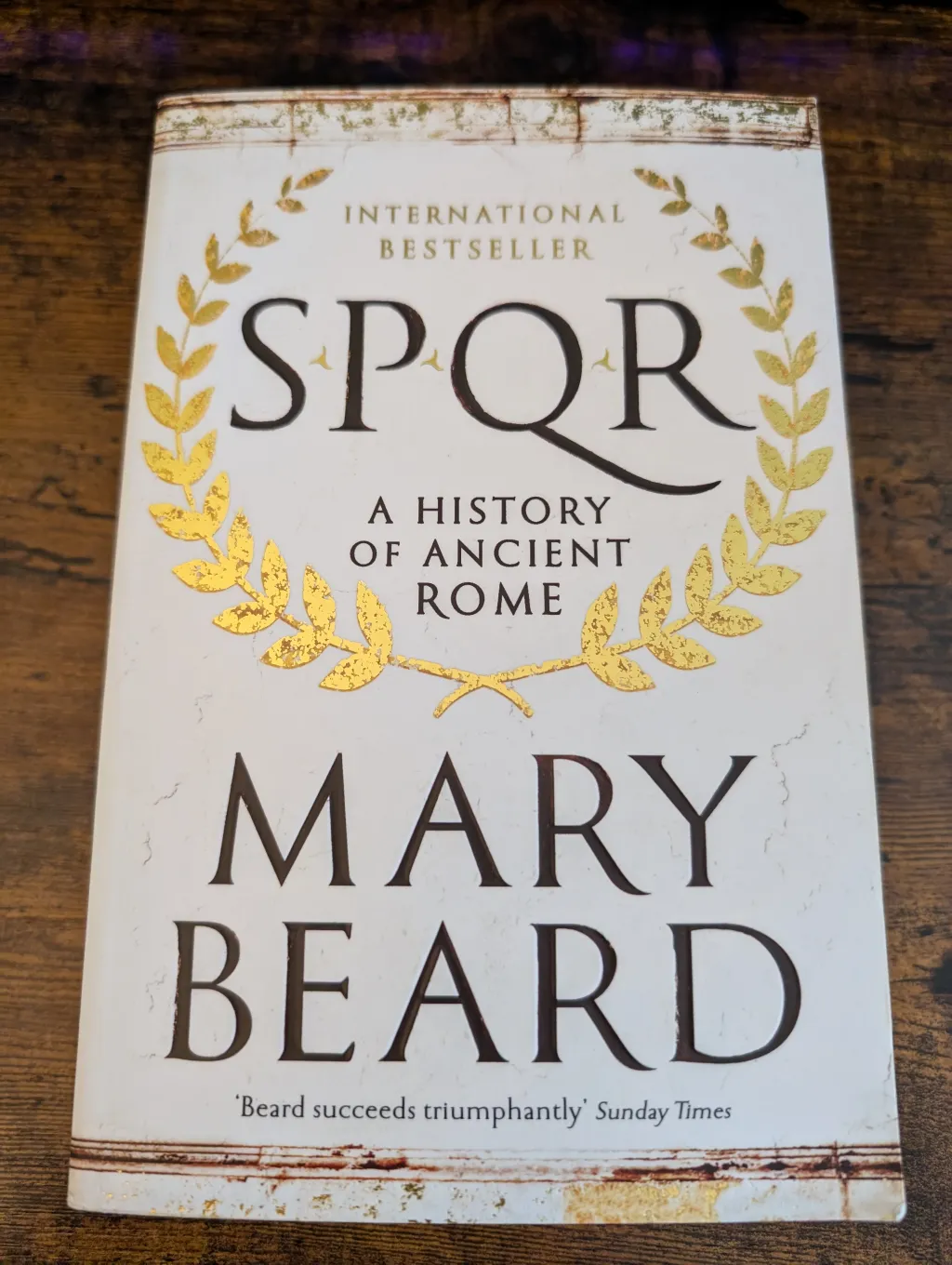
Within the first few pages of SPQR by Mary Beard, one reads about scientific studies of human excrement found in a cesspit in Herculaneum, Southern Italy (playfully, I have to say that first reading this made me think of the Latin phrase, scientia non olet). Beard then comments that, at least in this region, ancient
-
The great Richard Feynman once said (Caltech commencement address in 1974): “The first principle is that you must not fool yourself — and you are the easiest person to fool”. What Feynman is speaking to here is the tendency toward self-deceit – to think, even implicitly, that one knows absolutely, and for one to believe
-
One of the periods of human history that I most enjoy studying is the late Middle Ages, especially from a Western European perspective. There is a certain fecundity (in terms of ideas and the generation of concepts) about this period, which I think may be traced to a few principal roots. From these roots we
-

For readers who like to study history, whether rigorously or simply for the enjoyment of historical discussion, last week I finished listening to a series of podcasts – much more like a series of extensive lectures, with each entry spanning 4 to 5 hours in length – on the history of Japan and its involvement
-
R.C. Smith As far back as 4 million years ago and the period of Australopithecus afarensis, the standard model of hominin evolution offers valuable pieces of insight as to the importance of humanity’s great duel with nature. The current consensus, which is held by most scientists, places a significant moment in hominin evolution at the
-
I decided to make a video the other day on exponent properties. I like to think about mathematical concepts and to explore first principles. I spend a lot of my spare time working through proofs and also studying the history of mathematics and physics (as well as science in general). A natural extension of these
-
[An earlier unedited draft of this article was written with contributions by Arnold De Graaff. It has since become single authored and has been revised, updated and shortened.] “The Enlightenment”, Theodor Adorno and Max Horkheimer famously wrote, “understood in the widest sense as the advance of thought, has always aimed at liberating human beings” (Adorno
 Dialogues at still points